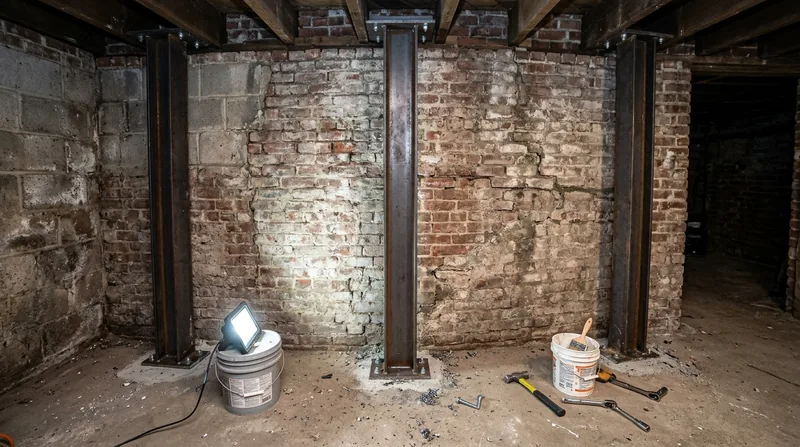




When a foundation wall starts to lean or bulge inward, the cause is almost always hydrostatic pressure from saturated soil pushing against masonry that was never engineered for it. In New York City, that story plays out in pre-war brick rowhouses across Brooklyn's Park Slope and Bedford-Stuyvesant, in the stone and brick houses perched on the hills of Riverdale and St. George, and in brownstones with old rubble-stone cellars in Manhattan. The ground here is a mix of fill, glacial sand and clay over bedrock schist, and the water table sits shallow near the harbor and tidal rivers. Freeze-thaw winters open joints, and nor'easter downpours drive water into the same clay that holds it. Our Bowing Wall Repair in New York City work stabilizes the wall, addresses the pressure behind it, and stops the movement from getting worse. If you are already seeing water at the wall base, start with a basement waterproofing assessment before the wall moves further.
Why Bowing Wall Repair Matters in New York City's Older Housing Stock
Most of the walls we stabilize were built between 1890 and 1950, when footings were shallow and drainage was an afterthought. In Queens neighborhoods like Forest Hills and Jackson Heights, attached brick homes share walls, so movement in one wall stresses the next. In the Bronx and Staten Island, hillside lots shed water toward the foundation. When the footing drain clogs or the soil stays saturated, pressure builds and the wall bows inward at mid-height.
- Horizontal cracks in a block wall or stair-step cracks in brick point to pressure, not settlement.
- Doors and windows that suddenly stick on the basement level signal the wall is moving.
- White efflorescence and damp patches at the crack line show water is already moving through.
- A visible bulge of an inch or more means the wall needs structural stabilization, not just sealing.
Cosmetic patching hides the symptom for a season and lets the movement continue. The right fix depends on how far the wall has moved and what is pushing it.
Key info: A 1920s brick rowhouse in Bay Ridge with a horizontal crack at mid-wall and a two-inch bulge is a classic pressure failure. Carbon fiber straps on the interior face, combined with correcting the exterior drainage, is usually the right sequence there. A brownstone in Manhattan with a rubble-stone wall and active seepage needs the pressure source addressed first. Structural repair permits are commonly required for foundation work, and the NYC Department of Buildings is the authority to verify requirements with. See the NYC Department of Buildings for current filing rules.
How We Repair a Bowing Wall in New York City
We start by reading the wall, not by selling a system. That means measuring the deflection, mapping the crack pattern, checking the footing, and finding where the water is coming from. In attached rowhouses we also check whether the shared wall is involved. Then we match the repair to the severity: straps for moderate movement, anchors or beams for walls that have rotated or where soil pressure is high.
- We excavate or open the interior to expose the wall face and confirm the failure mode.
- We relieve the pressure by correcting grading, downspout extensions, and the footing drain where accessible.
- We install carbon fiber straps or steel I-beams on the interior face, anchored into the footing and the floor framing above.
- We install wall anchors through the wall into the exterior soil where the wall has rotated and needs to be pulled back.
- We seal active cracks with epoxy or polyurethane injection and verify the wall is stable before closing up.
Every repair ends with a drainage plan, because a stabilized wall still fails if the water keeps coming. That is why we often pair the structural work with an interior drain tile system that manages water at the footing.
Key info: On a Cape Cod in Hempstead with a poured wall and a one-inch bow, we installed carbon fiber straps at four-foot spacing and corrected two downspouts that dumped at the foundation. On a 1930s brick Colonial in New Rochelle with a rotated block wall, wall anchors were the right call. Same symptom, different repair, because the wall and the soil told different stories.
Repair Methods We Match to the Wall and the Soil
There is no single fix for a bowing wall. The table below shows how we match the method to the movement and the pressure behind it. We explain the reasoning before any work starts so you can compare it against another contractor's proposal.
| Approach | Description | Best for |
|---|---|---|
| Carbon fiber straps | Straps bonded to the interior wall face and anchored top and bottom | Moderate bowing under two inches, block or poured walls |
| Steel I-beams | Beams set against the wall and tied into the floor and joists | Larger walls, heavier pressure, or where straps are not enough |
| Wall anchors | Anchors driven through the wall into exterior soil and tightened to pull it back | Walls that have rotated or leaned outward at the top |
| Crack injection | Epoxy or polyurethane injected through ports to fill and seal cracks | Active leaks and cracks that need sealing after stabilization |
| Drainage correction | Grading, downspout extensions, and footing drain repair to cut the pressure | Every bowing wall, because pressure is the root cause |
The structural repair holds the wall; the drainage correction keeps it from being pushed again.
Bowing Wall Repair Cost in New York City: What to Expect
Pricing for bowing wall repair starts at $600 for a focused crack injection or a small stabilization scope, and rises with the length of wall involved, the method, and the access. A rowhouse in Park Slope with a shared wall and a finished basement costs more to work around than a bare cellar in St. George. Wall anchors cost more than straps because the excavation and the anchor count add up. Getting two or three estimates is smart here, because the proposals should explain the failure mode, not just the price.
Factors that move the number: wall length and height, whether the wall is block, brick, or poured, how far it has moved, whether the footing drain needs repair, and whether interior finishes have to come out. Emergency stabilization after a nor'easter costs more than planned work. Our full pricing overview breaks down the ranges so you can compare proposals on the same basis.
Bowing Wall Repair Near Me: What to Check Before You Hire
When you search for bowing wall repair near me in New York City, you will get a mix of foundation generalists, plumbers, and waterproofing specialists. Ask each one how they diagnose the pressure source, because a contractor who only installs straps without addressing drainage is selling half a repair. Verify the license and insurance, and ask to see a certificate of insurance before work begins.
- Confirm the contractor is licensed and insured for structural foundation work in your borough.
- Get two or three written estimates that describe the method and the drainage correction.
- Ask for references from jobs in similar housing stock, like brick rowhouses or prewar brownstones.
- Ask who pulls the permit and whether the scope triggers a filing with the local building department.
- For attached homes, ask how they protect the shared wall and whether the neighbor needs notice.
Our contact and free estimate page is the fastest way to get a written scope for your wall.
Signs a Bowing Wall Needs Attention Now
Not every crack is an emergency, but some patterns should not wait for spring. A wall that has moved more than an inch, a horizontal crack that is widening, or a bulge you can see from across the basement needs a look now. In the older suburbs around White Plains and Mount Vernon, freeze-thaw cycles in January and February are when movement accelerates. In the low coastal blocks of Long Beach and Freeport, nor'easter surge and flash-flood downpours drive water against walls that were already under pressure.
- Measure the bulge at its deepest point and note whether it has grown since last season.
- Look for new cracks in the plaster or drywall above the wall line.
- Check for a musty smell or damp concrete, which means water is still moving through.
- Photograph the wall with a tape measure in frame so the change is documented.
If the wall is moving, the foundation crack repair scope is not enough on its own; the wall needs stabilization first.
Bowing Wall Repair in New York City: Pricing Guide
| Service | Price | Details |
|---|---|---|
| Crack injection and minor stabilization | Starting at $600 | Includes injection of active cracks and a small strap set; wall length and access move the price |
| Carbon fiber strap installation | Starting at $2,400 | Covers strap layout on a typical wall face; strap count and finish removal drive the number |
| Wall anchor system | Starting at $4,800 | Includes exterior excavation and anchor set; soil conditions and anchor count move the total |
| Steel I-beam reinforcement | On estimate | Needs an on-site look because beam spacing, wall height, and floor tie-in vary widely |
| Travel | Included | In New York City and surrounding areas, no separate call-out or mileage fee |
| Estimate | Free | Response within 24h at (929) 392-2158, no obligation to book |
Indicative pricing, the exact cost depends on square footage, finish, and site access. Free personalized estimate within 24h at (929) 392-2158.


