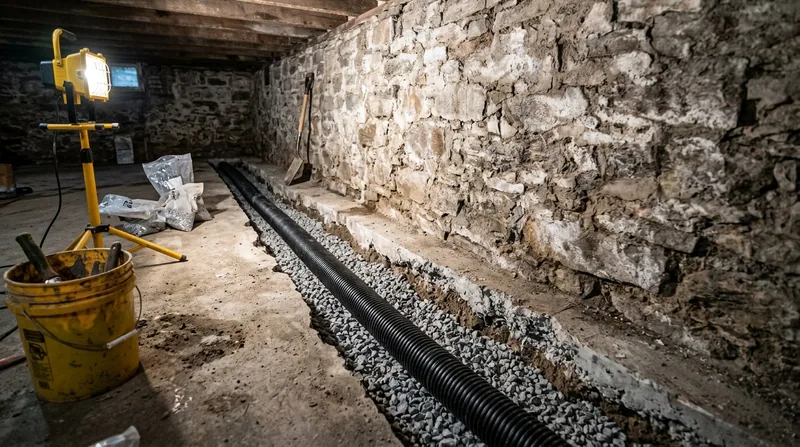




New York City sits on a patchwork of fill, glacial sand and clay over bedrock schist, and the water table runs shallow near the harbor and the tidal rivers. That means water in a Brooklyn cellar or a Queens basement does not come from rain alone. It comes up through the footing. An Interior Drain Tile System in New York City is the standard answer for that condition: we cut a channel along the inside of the footing, capture the water before it reaches the slab, and send it to a sump basin and pump. It works in pre-war brick rowhouses in Park Slope, stone and brick houses on the hills of Riverdale and St. George, and 1920s brick Colonials out in White Plains and Garden City. If your wet basement shows up after every nor'easter and every summer downpour, this is the system to price first. Start with a free basement inspection so we can confirm the water is coming from the footing and not from a failing wall.
Why Interior Drainage Matters in New York City's Older Basements
Most of the housing stock here was built before 1950, and much of it has no working footing drain. The original weeping tile, where it exists, is clay pipe that has collapsed or silted shut. Hydrostatic pressure builds under the slab, finds the weakest point at the cove joint, and pushes water across the floor. In Bedford-Stuyvesant and Bay Ridge we routinely find full basements with efflorescence halfway up the wall and a floor that stays damp all summer. Interior drain tile is the right call when the pressure is coming from below, not from a single crack.
- We intercept water at the footing before it can rise through the slab and wet the floor.
- We relieve hydrostatic pressure that bows block walls in older Queens and Bronx houses.
- We keep the system working through freeze-thaw winters when the ground heaves and cracks open.
- We tie the drain to a sump basin sized for the square footage of the basement, not a one-size box.
- We install it in any season, since the work is below grade and does not depend on dry weather.
That is the difference between mopping a wet basement every storm and drying it out once.
Key info: On a block-wall basement in Jackson Heights, we found the original clay weeping tile crushed under the footing and the sump pit dry. The water had nowhere to go but up through the slab. A new interior perimeter drain and a 1/3 HP pump ended three years of wet floors.
For the code side, drainage work that alters the sanitary connection of a sump discharge is regulated, and the NYC Department of Buildings is the authority to check before we cut. Rules vary by borough and by whether the discharge ties to storm or sanitary.
How We Install an Interior Drain Tile System in New York City
We do not guess at the water path. We start by mapping the basement, checking the wall for bowing and the floor for the low spot where water pools. Then we cut a trench along the perimeter at the footing, lay perforated pipe in washed stone, and cover it with a filter fabric and a concrete patch. The pipe runs to a sump basin at the low corner, and the pump discharges through a check valve to a line that carries water away from the foundation. The whole job stays inside the basement, so we do not dig up your yard or your stoop.
- We inspect the basement, test for moisture, and confirm the water source is the footing and not a wall crack.
- We cut the perimeter trench at the slab edge down to the footing and remove the spoil.
- We set the sump basin at the lowest point and connect the perforated pipe with the correct fall.
- We backfill with washed stone, wrap the pipe in filter fabric, and patch the slab with concrete.
- We install the pump, check valve, and discharge line, then run water through the system to prove it moves.
Where the wall is also seeping, we pair the drain with basement wall sealing so the drain handles the floor and the sealer handles the wall.
Key info: In a 1920s brick Colonial in New Rochelle, the basement floor sat 14 inches below the footing on one side. We stepped the trench to keep the pipe fall correct and set the sump basin at the true low point. A flat trench would have left standing water in the corner.
Interior Drain Tile vs. Other Approaches
Not every wet basement needs the same fix. A single vertical crack with dampness around it is a crack injection job, not a drain. A wall that is bowing needs carbon fiber straps or anchors before any drainage work. The table below shows where interior drain tile fits against the alternatives we see most in New York City.
| Approach | Description | Best for |
|---|---|---|
| Interior perimeter drain tile | Perforated pipe set at the footing inside the basement, feeding a sump basin and pump | Hydrostatic pressure under the slab, wet floors after rain, high water table |
| Exterior footing drain | Pipe and membrane installed outside the foundation wall after excavation | Wall seepage with accessible exterior, major regrading needed |
| Crack injection | Epoxy or polyurethane injected through ports into a single crack | One active crack, no floor water, no footing pressure |
| Sump pump only | Basin and pump without a perimeter drain | Existing drain tile that still flows, pump replacement |
| Bowing wall repair | Carbon fiber straps or wall anchors to stop inward movement | Block walls pushed in by soil and water pressure |
If the floor is wet and the walls are dry, the drain is the answer. If the wall is moving, we fix the wall first.
Interior Drain Tile System Cost in New York City: What to Expect
Pricing starts at $50 per linear foot for a standard interior perimeter drain, and most full-basement jobs in the boroughs land in a range that reflects the run length, the wall material, and whether we are replacing a failed system or starting fresh. A 30-foot run in a small Bay Ridge basement is a different number than a 120-foot perimeter in a Forest Hills two-family with a finished floor to cut and restore. Access matters too: a basement with a narrow rear extension takes longer to work than an open cellar. We quote from the actual layout, not from a phone estimate. You can see the full breakdown on our pricing page, and we always recommend getting two or three estimates so you can compare scope, not just the bottom line.
What moves the price up: longer runs, concrete floor restoration, a sump basin cut through a thick slab, and pairing the drain with a new pump or battery backup. What keeps it down: an unfinished basement, easy access, and an existing sump pit we can reuse.
What to Look For in a Waterproofing Contractor Near Me in New York City
Waterproofing attracts a lot of one-truck operators, and a bad drain install is expensive to fix. Ask for the license and insurance certificate before anyone walks into your basement, and confirm the coverage is current. Get at least two written estimates that spell out the pipe size, the stone, the pump model, and the discharge route. Ask for references from jobs in your borough, and call one. Permits are commonly required for work that alters drainage or the sanitary connection of a sump discharge, and the local building department has the final word, so a contractor who tells you no permit is ever needed is telling you something. If you are in a co-op or a landmark district, check the building rules and any exterior work restrictions before the crew arrives.
Reach out through our contact page to set up the inspection.
Interior Drain Tile System in New York City: Pricing Guide
| Service | Price | Details |
|---|---|---|
| Interior perimeter drain tile, standard run | Starting at $50/linear ft | Includes trench, perforated pipe, washed stone, filter fabric, and concrete patch along the footing. |
| Drain tile plus new sump basin and pump | Starting at $2,800 | Adds basin, 1/3 HP pump, check valve, and discharge line to an existing exterior outlet. |
| Full basement with finished floor restoration | On estimate | Requires on-site look at slab thickness, floor covering, and access before a number is given. |
| Drain tile plus battery backup sump pump | Starting at $3,600 | Adds backup pump and battery for storm outages, sized to the basin and run length. |
| Travel | Included | In New York City and surrounding areas, no separate call-out or mileage fee. |
| Estimate | Free | Response within 24h at (929) 392-2158, no obligation to book. |
Indicative pricing, the exact cost depends on square footage, finish, and site access. Free personalized estimate within 24h at (929) 392-2158.


