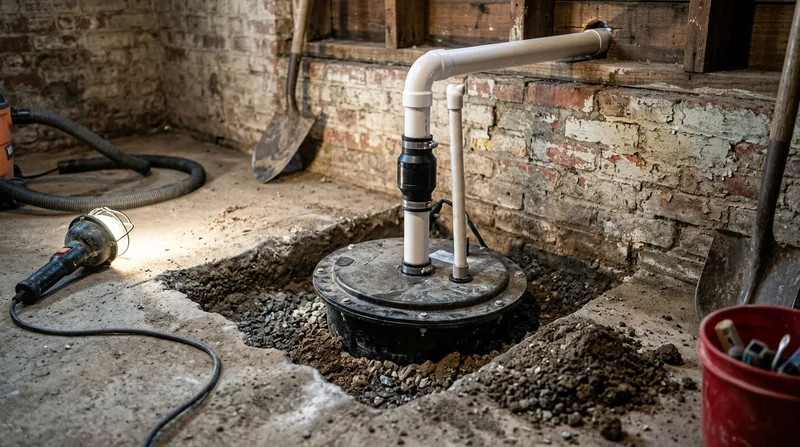




If you have ever stood in a flooded Brooklyn cellar at 2 a.m. after a nor'easter, you already know why a sump pump installation and replacement in New York City is not a luxury. The city sits on fill, glacial sand and clay over bedrock schist, and the water table runs shallow near the harbor and the tidal rivers. A failed pump in Park Slope or Bay Ridge means water rising through a sump basin that has nothing left to push it out. We install properly sized pumps, sealed basins and discharge lines that keep up with cloudbursts and tidal groundwater rises. If your pump is cycling constantly or has gone silent, start with a battery backup sump pump review before the next storm season.
Why Sump Pump Failure Is the Number One Wet Basement Call in New York City
Pre-war brick rowhouses in Bedford-Stuyvesant, attached Tudors in Forest Hills and stone houses on the hills of Riverdale all share the same weak point: a single pump with no backup. When the power drops during a summer downpour or the float switch sticks on a humid August night, hydrostatic pressure pushes groundwater through the footing drain and into the basin. The pump is the last line of defense, and in this city it fails most often during the exact storm that fills the basin fastest.
- Pumps burn out when they cycle every few minutes because the basin is undersized or the check valve leaks back.
- Discharge lines freeze at the exterior wall during freeze-thaw winters, and the pump runs dry and overheats.
- Iron bacteria and glacial clay silt clog the intake screen, so the pump runs but moves almost no water.
- Older cast-iron pumps in Queens and Staten Island basements finally seize after fifteen or twenty years of service.
We replace the pump, the check valve and the discharge routing as one system, because a new pump on a bad line fails just as fast as the old one.
Key info: In low coastal blocks of Long Beach and the Rockaways, nor'easter surge and flash-flood downpours can raise the water table faster than any pump can clear it. A sealed basin with a battery backup is the minimum, not the upgrade.
New York City plumbing and drainage rules are enforced by the NYC Department of Buildings, and discharge connections must follow local code, so confirm the routing before the pump goes in.
How We Install or Replace a Sump Pump in New York City Basements
Every job starts with a free basement inspection, because the pump is only as good as the basin and the drain tile feeding it. We check the interior perimeter drain, the footing drain condition, the discharge slope and the grading outside. In a Forest Hills attached brick home, the discharge often has to run through a masonry wall to a dry well or splash block, and we plan that route before we cut anything.
- We inspect the sump basin, drain tile inflow and existing discharge line, then measure the actual inflow during a rain event or a controlled test.
- We size the pump to the basin volume and the head height, typically a 1/3 to 1/2 HP cast-iron or thermoplastic pump for a residential cellar.
- We set a sealed, gasketed basin lid with a floor drain collar to control moisture and radon-free air movement, and to stop debris from dropping in.
- We install a brass or PVC check valve and a full-flow discharge line with a freeze-resistant termination.
- We wire the pump to a dedicated GFCI circuit and test the float through several full cycles before we leave.
If the basin itself is cracked or undersized, we set a new pit, and if the inflow exceeds what a single pump can handle, we pair the primary with a interior drain tile system review so the water reaches the pump instead of the floor.
Key info: In a St. George, Staten Island hillside house, the footing drain runs to a basin at the low corner. When the old pump seized, the basin overflowed into the finished room within an hour. We replaced the pump, reset the check valve and added a battery backup in a single visit.
Sump Pump Approaches We Use in New York City
The right approach depends on the basin, the inflow and how the discharge leaves the building. Here is how we match the equipment to the house.
| Approach | Description | Best for |
|---|---|---|
| Primary pump replacement | New cast-iron or thermoplastic pump, check valve and float in the existing basin. | A working basin with a seized or noisy pump. |
| New sump pit and sealed basin | Cut and set a new pit with a gasketed lid and discharge collar. | Cracked basins, no pit, or a basin too small for inflow. |
| Battery backup system | Secondary pump on a deep-cycle battery with an alarm. | Power outages during nor'easters and summer storms. |
| Discharge line correction | Reroute the line to a freeze-resistant, code-compliant termination. | Frozen lines, short cycling and water dumping back at the wall. |
| Dual pump setup | Two pumps on alternating floats in one basin. | High-inflow basements near the harbor and tidal rivers. |
We choose the approach after we see the inflow, not from a catalog, because a pump that is too small for a Bay Ridge cellar will cycle itself to death in one season.
Sump Pump Installation & Replacement Cost in New York City: What to Expect
Most homeowners want a number before they call, and that is fair. A straightforward pump replacement in an existing basin starts from $1,200, and that figure covers the pump, check valve, float and labor. The price moves from there based on the basin condition, the discharge route, the pump capacity and whether a battery backup goes in at the same time.
Access matters in this city. A basement with a finished ceiling and a tight mechanical closet takes longer to work in than an open cellar in Mount Vernon. A discharge line that has to cross a masonry wall or run to a dry well adds time and materials. High-inflow sites near the harbor may need a larger pump or a dual setup. Get two or three written estimates, compare the pump model and the warranty, not just the bottom line. Our full pricing overview breaks down the ranges.
Cheap quotes often skip the check valve or reuse the old discharge line, and that is exactly where a replacement fails first.
What to Look For in a Sump Pump Contractor Near Me in New York City
Hiring the right contractor matters more than the pump brand. Ask for the license and insurance certificate before work starts, and confirm the company specializes in below-grade waterproofing rather than general handyman work. Call two recent references in your borough and ask whether the pump has run through a full storm season without cycling.
- Confirm the contractor is licensed and insured, and ask for the certificate to be sent before the start date.
- Get two or three written estimates that list the pump model, basin work and discharge routing separately.
- Ask whether a permit is required for the discharge connection in your borough, and who pulls it.
- Check that the quote includes a transferable warranty on the pump and the installation labor.
If a contractor cannot explain why your basin filled, they are guessing at the pump size. Reach out through our contact page and we will schedule a free inspection.
Key info: In 1920s brick Colonials in Hempstead and Garden City, the discharge often runs to a splash block at the foundation. That works until the ground freezes, so we route it to a dry well or a freeze-resistant termination instead.
Ask for the estimate in writing, compare the scope line by line, and do not let a low bid talk you out of a check valve or a sealed lid.
Sump Pump Installation & Replacement in New York City: Pricing Guide
| Service | Price | Details |
|---|---|---|
| Pump replacement in existing basin | Starting at $1,200 | Includes pump, check valve, float and labor; capacity and brand move the price up. |
| New sump pit and sealed basin | Starting at $1,800 | Covers cutting and setting the pit, gasketed lid and discharge collar; access drives cost. |
| Battery backup system added | Starting at $650 | Secondary pump, deep-cycle battery and alarm; battery size and pump capacity change the figure. |
| Discharge line correction | Starting at $450 | Reroute to a freeze-resistant termination; wall penetration and run length move the price. |
| Complex or high-inflow job | On estimate | Dual pumps, large basins and tidal groundwater sites need an on-site look before a number. |
| Estimate | Free | Response within 24h at (929) 392-2158, no obligation to book. |
Indicative pricing, the exact cost depends on square footage, finish, and site access. Free personalized estimate within 24h at (929) 392-2158.


