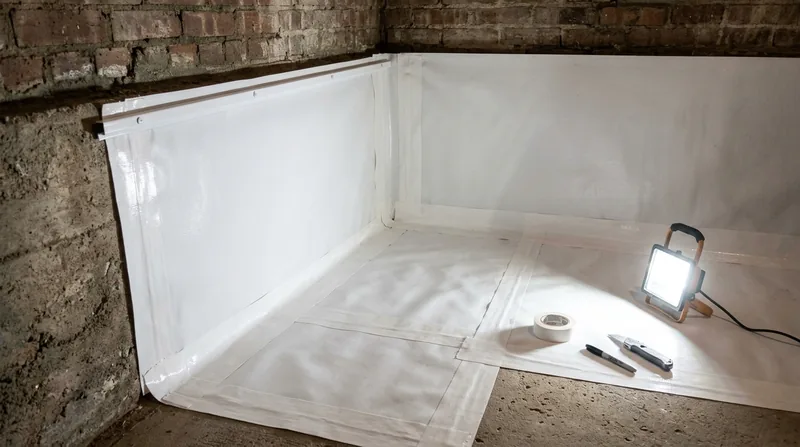




Vapor Barrier Installation in New York City
New York City sits on fill, glacial sand and clay over bedrock schist, and the water table runs shallow near the harbor and the tidal rivers. That ground holds moisture year round, and it pushes vapor through old stone and brick foundation walls into Park Slope cellars, Forest Hills basements and Riverdale lower levels. Vapor Barrier Installation in New York City puts a heavy-duty sheet across walls and slab so that ground vapor stays in the soil where it belongs, not on your joists, boxes and stored furniture. We are a dedicated below-grade specialist, not a general foundation firm or a plumber, and we tell you plainly when a barrier is the right call and when hydrostatic pressure needs drainage first. Start with a free basement inspection and we will show you where the moisture is actually coming from.
Why Vapor Barrier Installation Matters in New York City's Older Masonry Basements
Pre-war brick rowhouses in Bedford-Stuyvesant and Bay Ridge, brownstones in Manhattan, and the 1920s-50s brick Colonials and Cape Cods across the Westchester and Nassau line share one problem: old masonry walls that breathe moisture inward all year. You see it as efflorescence, a musty basement smell, and damp cardboard within a week of a rain event. A vapor barrier is the layer that stops that vapor at the wall and slab instead of letting it condense on cool surfaces.
- We block vapor that migrates through stone and brick foundation walls and through bare slab.
- We seal seams, tape terminations and integrate the sheet with the sump basin where drainage exists.
- We keep moisture out of the building materials, which is the factual basis for preventing mold growth.
- We work around interior perimeter drain and drain tile systems instead of burying them under plastic.
For damp masonry cellars, the barrier is often the single most effective step after drainage is handled, and it is far less disruptive than exterior excavation.
Key info: In St. George on Staten Island and along the low coastal blocks near the harbor, nor'easter surge and flash-flood downpours drive the water table up fast. Those homes usually need drainage and a sump before a barrier goes on the wall, and we say so at the inspection.
New York State and New York City building rules are enforced locally, so confirm scope requirements with the NYC Department of Buildings before work that alters drainage or structural elements begins.
How We Install Vapor Barriers in New York City Basements
Every job starts with a moisture read, not a sales pitch. We check the walls for active seepage, test whether the slab is wicking, and look at how the footing drain and sump are performing. If hydrostatic pressure is the real driver, we tell you that an interior drain tile system comes first and the barrier follows.
- We clear the perimeter, inspect the walls and slab, and mark any crack that needs epoxy or polyurethane injection before covering.
- We fasten heavy-duty barrier sheets to the wall with mechanical terminations and run them down over the footing.
- We seal every seam with compatible tape and mastic so the sheet reads as one continuous membrane.
- We terminate the bottom edge into the drainage gravel or sump basin and seal around pipes and penetrations.
- We leave a serviceable detail at the sump so the pump and check valve stay accessible.
The result is a sealed lower level you can actually use for storage and laundry without fighting dampness every season.
Key info: A two-family home in Jackson Heights had damp brick walls and a musty smell after every summer storm. We sealed two hairline cracks, installed the barrier over the full wall and slab, and tied the base into the existing sump. The owner reported dry storage within the first month.
Vapor Barrier Approaches We Use in New York City
Not every basement takes the same sheet or the same detail. The right approach depends on wall type, whether drainage exists, and how much headroom you can afford to lose. Here is how we match the method to the building.
| Approach | Description | Best for |
|---|---|---|
| Wall sheet with dimple board | Barrier fastened to the wall with a drainage mat behind it to relieve pressure. | Damp brick and stone walls in older rowhouses. |
| Slab vapor barrier | Heavy sheet laid over the slab with taped seams and sealed edges. | Wicking slabs and finished lower levels. |
| Sump-integrated barrier | Sheet tied into the sump basin with a serviceable lid and check valve access. | Basements with active drainage and a sump pump. |
| Partial wall barrier | Sheet run on the wet wall only, sealed at the top and base. | One-sided seepage where full coverage is not needed. |
Vapor Barrier Installation Cost in New York City: What to Expect
Most residential barrier work starts from $3 per square foot, and that figure covers the sheet, fasteners, seam tape and standard terminations. The number moves with wall height, how much prep the old masonry needs, whether cracks need injection first, and how tight the access is in a narrow rowhouse cellar. A finished lower level with stored contents takes longer than an empty one.
We give you a written scope so you can compare like for like. Get two or three estimates, ask what sheet thickness and seam method each one uses, and check whether sump integration is included or billed separately. Our full pricing overview lays out how each factor changes the total.
What to Look For When Hiring a Waterproofing Contractor Near Me in New York City
Basement work is easy to sell and hard to do right, so screen the contractor before you sign. Ask for the license and insurance certificate, and confirm the policy covers below-grade work. Get at least two written estimates with the same scope, and ask for recent references from homes with the same wall type as yours.
- Confirm the contractor is licensed and insured and will show a certificate on request.
- Ask how they handle permits with the local building department for any drainage or structural change.
- Check references from nearby jobs, ideally in your borough and with similar masonry.
- Make sure the quote states sheet thickness, seam method and whether sump integration is included.
If a quote promises a lifetime warranty or skips the inspection, walk away. Call us at (929) 392-2158 or use the contact page to book a free, no-obligation look at your basement.
We also serve nearby suburbs such as Yonkers and Hempstead, where 1920s-50s block and poured walls take the same freeze-thaw winters.
Vapor Barrier Installation in New York City: Pricing Guide
| Service | Price | Details |
|---|---|---|
| Wall vapor barrier | Starting at $3/sq ft | Includes sheet, fasteners, seam tape and standard terminations; wall height and prep move the price |
| Slab vapor barrier | Starting at $3/sq ft | Includes heavy sheet, taped seams and sealed edges; contents removal and access add cost |
| Sump-integrated barrier | On estimate | Ties the sheet into the basin with serviceable lid and check valve access; existing drain condition sets scope |
| Complex or large-scale job | On estimate | Multi-room cellars and masonry needing crack injection first require an on-site look before pricing |
| Travel | Included | In New York City and surrounding areas, no separate call-out or mileage fee |
| Estimate | Free | Response within 24h at (929) 392-2158, no obligation to book |
Indicative pricing, the exact cost depends on square footage, finish, and site access. Free personalized estimate within 24h at (929) 392-2158.


