



Exterior Basement Waterproofing in New York City: Digging Down to the Real Problem
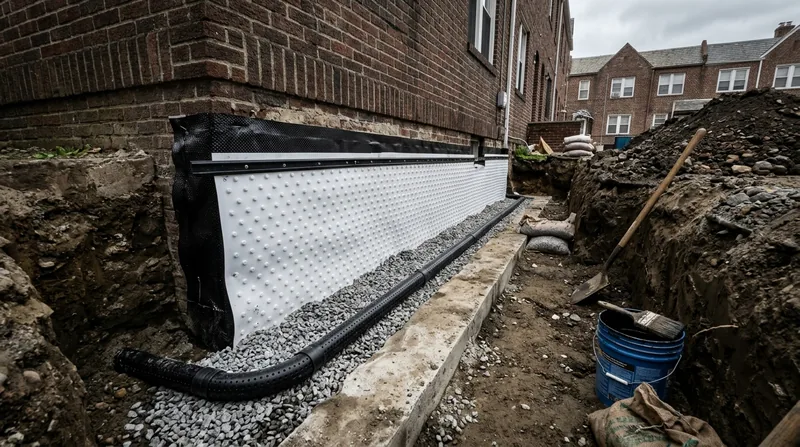
Exterior Basement Waterproofing in New York City starts where the water actually enters: the outside face of the foundation wall, below grade, at the footing. In Brooklyn's Park Slope and Bay Ridge, that means brick rowhouses whose old stone footings sit in glacial sand and clay fill. In Queens, Forest Hills and Jackson Heights attached brick homes share walls and tight side yards. In Riverdale and St. George, houses sit on slopes where runoff hits the uphill wall first. In Manhattan, brownstones have cellar levels behind prewar masonry that has been wicking moisture for a century. We excavate down to the footing, apply a waterproof membrane or dimple board directly to the wall, correct the grading, and extend the downspouts. If your seepage is on the outside face, this is the permanent fix. Start with a free basement inspection so we can confirm the source before anyone digs.
Why Exterior Waterproofing Matters in New York City's Older Housing Stock
Most of New York City's residential basements were built before 1950, and many before 1930. Those foundation walls are old brick, stone, or early poured concrete with no modern damp-proofing, and the ground around them is a mix of fill, glacial sand, and clay over bedrock schist. When the water table rises near the harbor and tidal rivers, or a nor'easter dumps three inches in an hour, hydrostatic pressure pushes water straight through the masonry. You see it as wall seepage, efflorescence, and a musty basement smell that comes back every spring.
- Attached brick rowhouses in Bedford-Stuyvesant and Bay Ridge often have shared party walls where interior drainage alone cannot stop lateral seepage.
- Homes in Forest Hills and Flushing sit on clay soil that holds water against the foundation for days after a storm.
- Riverdale and St. George hillside houses take runoff from uphill neighbors, which loads the exterior wall before it ever reaches the drain tile.
- Freeze-thaw winters open hairline cracks in parging and masonry, giving water a direct path into the basement.
When the seepage is on the outside face and you have access along the side or rear yard, exterior waterproofing is the most direct fix available.
Key info: A 1920s brick Colonial in Garden City with a block foundation and wet rear wall is a classic exterior job. The same seepage pattern in a Park Slope rowhouse with no side access may call for an interior drain tile system instead. The building decides the method, not the sales pitch.
New York City requires permits for structural foundation work and for anything that alters drainage or the sanitary connection of a sump discharge. Verify the current rules with the NYC Department of Buildings before work begins, since thresholds vary by borough and project type.
How We Do Exterior Basement Waterproofing in New York City
We work from the outside in, and we do not open a trench until we have confirmed where the water is coming from. On a typical job we hand-dig or machine-excavate along the wall to the footing, clean the masonry, repair any cracks with epoxy or polyurethane injection, then apply the membrane and dimple board. We restore the grade so it slopes away from the house, and we extend the downspouts well past the foundation. On tight lots in Queens and Manhattan, we shore the excavation and work in short sections to protect the neighboring structure.
- We inspect the basement interior and the exterior grade, and we check the drain tile and downspout discharge points.
- We excavate down to the footing, exposing the full height of the foundation wall.
- We repair cracks and parging, then apply a waterproof membrane and dimple board against the wall.
- We correct the grading, extend the downspouts, and tie the footing drain into a sump basin where the design calls for it.
- We backfill in lifts with proper compaction and restore the surface.
Every job ends with a walkthrough so you know what was done, what to watch for, and when to call us back.
Key info: In Hempstead and Valley Stream, we routinely find 1950s split-levels where the downspouts dump right at the corner of the foundation. Extending them and correcting the grade solves a surprising share of wet basement calls before any excavation is needed. See our Hempstead exterior waterproofing page for a local example.
Exterior Waterproofing Methods We Use in New York City
| Approach | Description | Best for |
|---|---|---|
| Membrane plus dimple board | A waterproof membrane applied to the cleaned wall, protected by dimple board that creates a drainage gap. | Brick and block walls with active seepage and yard access along the wall. |
| Footing drain replacement | New perforated drain tile at the footing, bedded in gravel and wrapped in filter fabric. | Old clay or collapsed weeping tile that no longer carries water away. |
| Crack injection and parging repair | Epoxy or polyurethane injection into cracks, plus fresh parging where the old coat has failed. | Isolated cracks and spalling masonry on an otherwise sound wall. |
| Grading and downspout correction | Regrading soil to slope away from the house and extending downspouts past the foundation. | Shallow seepage after rain and wet corners near downspout outlets. |
| Interior drain tile (when exterior access fails) | An interior perimeter drain that intercepts water at the wall base and carries it to a sump basin. | Attached rowhouses and tight lots where excavation would undermine a neighbor. |
Exterior Basement Waterproofing Cost in New York City: What to Expect
Pricing for exterior work starts at $95 per linear foot and moves up from there. The figure reflects excavation, wall preparation, membrane and dimple board, and backfill. What drives it higher is access: a wide-open rear yard in Rockville Centre is a different job from a two-foot side passage in Jackson Heights. Depth to the footing, soil type, the condition of the old wall, and whether the footing drain needs replacement all factor in. So does the cost of shoring and hand-digging where a machine cannot fit.
We give you a written scope with the linear footage and the materials spelled out, so you can compare bids line by line. Getting two or three estimates is smart on any job of this size, and it is the fastest way to spot a quote that skips the footing drain or the backfill. Our full pricing overview breaks down how the numbers are built.
Hiring an Exterior Basement Waterproofing Contractor Near Me in New York City
Ask three questions before you sign anything. First, are they licensed and insured, and can they produce a certificate of insurance on request. Second, do they do this work as a specialty or as a sideline to general foundation repair. Third, will they put the scope in writing, including the linear footage, the membrane product, and what happens to the footing drain. A contractor who cannot answer those plainly is not the one you want digging next to your neighbor's wall.
Check references from jobs in your borough, and ask whether the permit was pulled in the owner's name. In New York City, structural foundation work and any change to drainage or the sump discharge connection may require a permit, and the rules vary by jurisdiction, so confirm with the local building department. If your property sits in a historic district or has a shared party wall, ask about that up front too.
Call us at (929) 392-2158 or request a free estimate. We will tell you plainly whether exterior excavation is the right answer or whether an interior drain tile system makes more sense for your building.
Exterior Basement Waterproofing in New York City: Pricing Guide
| Service | Price | Details |
|---|---|---|
| Exterior membrane and dimple board | Starting at $95/linear ft | Includes excavation, wall prep, membrane, dimple board, and backfill along the foundation wall. |
| Footing drain replacement | Starting at $110/linear ft | New perforated drain tile bedded in gravel with filter fabric, tied to the discharge point. |
| Crack injection and parging repair | Starting at $450 per crack | Epoxy or polyurethane injection with ports, plus parging where the old coat has failed. |
| Grading and downspout correction | Starting at $1,200 | Regrading soil away from the house and extending downspouts past the foundation. |
| Complex or large-scale job | On estimate | Tight side yards, shoring, hand-digging, and deep footings need an on-site look before a number. |
| Estimate | Free | Response within 24h at (929) 392-2158, no obligation to book the work. |
Indicative pricing, the exact cost depends on square footage, finish, and site access. Free personalized estimate within 24h at (929) 392-2158.


