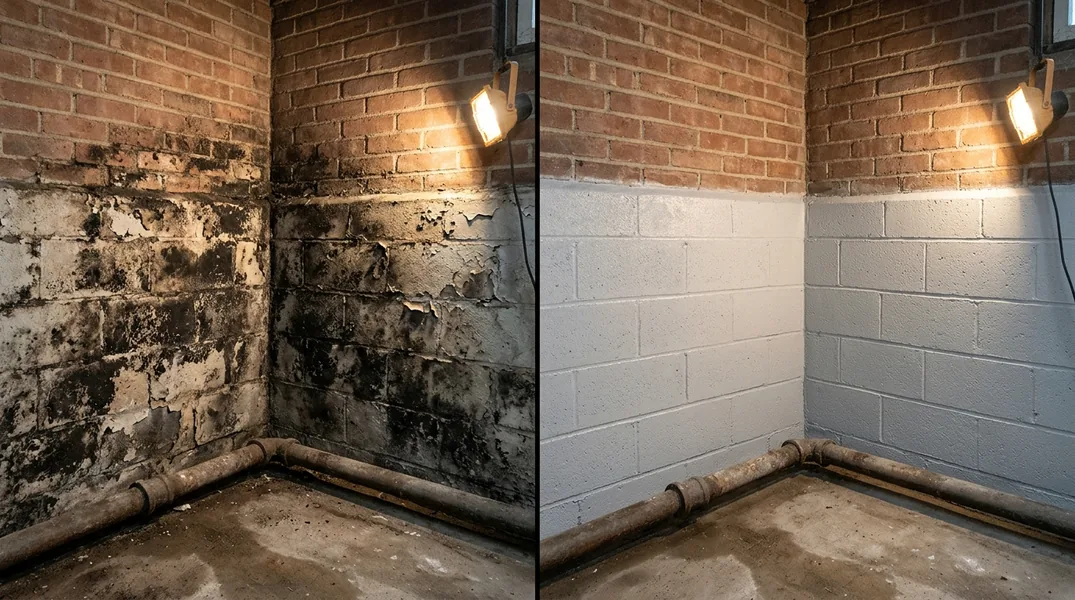
Why Rowhouse Basements Leak Differently in New York City
A rowhouse is not a suburban ranch with a lawn on all four sides. Your home shares walls with neighbors, sits close to the street and sidewalk, and often has a rear yard barely wide enough for a ladder. That geometry changes everything about how water reaches your basement. Most leaks in New York City rowhouses come from three directions: hydrostatic pressure pushing groundwater through the cove joint where the floor meets the wall, surface water sheeting down the areaway or light well, and failed or missing exterior damp proofing on a foundation that is now over a century old.
Because you cannot easily dig up a shared party wall or excavate a four foot side yard without touching a neighbor's property, the interior versus exterior question is not purely technical here. It is practical. Some blocks in Brooklyn, Queens, and Manhattan simply cannot accommodate an exterior excavation, while others in the Bronx or Staten Island have enough clearance to make it viable. Understanding what each approach actually does is the first step toward choosing the right fix for your specific rowhouse.
How Interior Drain Tile and Membrane Systems Work
An Interior Drain Tile System is installed on the inside of your foundation. The crew breaks a channel along the perimeter of the basement floor, lays perforated pipe in a bed of gravel, and connects it to a sump pit with a pump. Water that seeps through the wall or rises under the slab gets captured and discharged away from the house. A dimpled membrane can be added against the wall to channel seepage down to the drain without letting it soak the concrete.
The advantage for rowhouse owners is that this work happens entirely inside your property. No permits from a neighbor, no digging up the sidewalk, no risk of undermining a shared foundation. It also addresses both wall seepage and rising groundwater, which is common in low-lying parts of Yonkers and similar river-adjacent neighborhoods. The tradeoff is that interior systems manage water after it enters the basement rather than stopping it at the wall. For most finished or semi-finished rowhouse basements, that is an acceptable and often preferred solution because it can be installed year round and does not disturb landscaping or hardscaping.
When Exterior Basement Waterproofing Makes Sense
Exterior Basement Waterproofing attacks the problem from the outside. The crew excavates down to the footing, repairs cracks, applies a waterproof membrane to the foundation wall, installs drainage board, and backfills with gravel to direct water away. This is the gold standard for stopping water before it ever touches the structure, and it is the right call when the foundation itself is deteriorating, when the leak is clearly coming through a wall crack, or when you are already excavating for another reason.
In rowhouse settings, exterior work is often feasible on the front areaway or rear yard but rarely on the party wall sides. That partial access can still be valuable. If your leak is concentrated at the front light well or the rear extension, an exterior approach on those faces may solve the problem without touching the shared walls. A reputable Basement Waterproofing contractor will tell you honestly whether your property has the clearance and access to make exterior work worthwhile, rather than selling you an excavation you do not need.
Drain Tile vs Membrane: What Actually Stops a Rowhouse Leak
Homeowners often ask whether they need drain tile, a membrane, or both. The honest answer depends on where the water is coming from. If water is rising through the floor slab or seeping at the cove joint, drain tile is doing the heavy lifting. If water is wicking through the wall itself and making the concrete damp or causing efflorescence, a membrane or crystalline coating on the interior face is the missing piece. Many rowhouses need the combination: membrane on the wall to intercept seepage, drain tile at the base to carry it away.
This is also where Foundation Waterproofing overlaps with basement finishing. If you plan to convert the basement into a rental unit, a home office, or a family room, you want a system that keeps the space dry enough for drywall and flooring, not just one that prevents standing water. Talk through your intended use with your contractor before signing anything, because the right system for a storage cellar is not the right system for a finished apartment.
Basement Waterproofing Cost in New York City: What to Budget
Cost is the question every homeowner asks, and the honest answer is that it varies widely by method, access, and the condition of your foundation. Interior systems are generally less expensive because they do not require excavation, permits for sidewalk or street work, or restoration of hardscaping. Exterior work costs more per linear foot because of the digging, disposal, and rebuild, and in rowhouse settings it may require coordination with adjacent property owners. A partial exterior scope on just the front or rear face can be more affordable than a full perimeter job.
Rather than guess, ask for a written scope that separates labor, materials, disposal, and any restoration. You can review general pricing guidance on our site, but the only reliable number comes from an on-site inspection. Be wary of any contractor who quotes a flat price over the phone without seeing your basement, your areaway, and your foundation. For a straightforward comparison, request a free estimate and ask specifically which method they recommend and why.
Basement Waterproofing Near Me: Choosing a Local Contractor
Searching for basement waterproofing near me in Mount Vernon or anywhere in the five boroughs returns a long list of companies, and not all of them understand rowhouse construction. A contractor who mostly works on suburban slabs may not know how to handle a shared party wall, a front areaway drain, or a basement that sits below the sewer line. Ask whether they have worked on your block type, whether they pull the required permits, and whether they offer a transferable warranty on the system.
Also ask what happens after installation. A sump pump needs testing, a drain line needs clearing, and a membrane needs inspection if you ever renovate. A local company that can return in a year or five years is worth more than a slightly lower bid from someone who will not. If you are in New Rochelle or anywhere in our service area, call New York City Waterproofing at (929) 392-2158 to schedule an inspection and get a clear recommendation for your rowhouse.
Looking for a professional basement waterproofing contractor in New York City? New York City Waterproofing responds fast for all your basement waterproofing needs.
Get a Free QuoteOur services: Basement Waterproofing · Interior Drain Tile System · Exterior Basement Waterproofing